


Giacosa - Car hire with driver  - Monforte D'Alba - Tel. 017378227 - Fax. 0173789615 - E-Mail: info@maurogiacosa.com
Car hire with driver
  Giacosa's Car Hire With Driver - The Spot
Giacosa's car hire with driver is 10 km away from Alba and it is placed in the heart of the Langhe, besides the frequent travels in the major italian cities, we perform lots of excursions in the hills surrounding the town of Alba.
In those areas, where the king of the bulbs, the white triffle grows, you have the unique chance to visit ancient castles, medieval villages, wine cellars and awesome sites of the Langhe.
Follows a list of the most popular turist areas that can be visited through our service. This list includes pictures and descriptions of each area.
The town of Grinzane Cavour is famous for its breath-cutting vineyards, for the wine cellars and for the castle that stands on the top of the hill overheading the valley. The castle was built by Camillo Benso in the medieval age, and then, in the first years of the twentieth century, it has been restored. Now it is one of the most famous italian restaurants.
Grinzane's Castle
While visiting Serralunga you will have the chance to see one of the most important castles of all the Langhe and the Piedmont region. It has been built in the period between 1340 ant 1360, it is characterized by the different shape of its three towers: the first has a circular base, the second has a rectangular base while the third has a square base. It is necessary to pinpoint also the ancient walls that enclose the charateristic medieval village. Serralunga is also famous for its vineyards and comfortable wine cellars.
Serralunga's castle and castle wall
The area that contains the castle and the village of Barolo is very particular compared to the sites where are placed the other Langhe's towns. In fact the village stands in a natural hollow in the hills; this particural placing has been anciently occupied to leave enough place on the hills to grow the notorious vineyards of Barolo. The village, besides beeing the place where this precious wine is produced, hosts a famous castle, built by the Barolo marquises. The inside is open to the public, and it is possible to view paintings and furnitures in imperial style.
View of Barolo and vineyards
Monforte, layed on the hill that gives the name to that city, belongs to the area where the Barolo is produced. It is one of the most important centres in the Langhe, and it has become one of the most important touristic destinations, offering delicious dishes such as triffles, local dishes and the pleasing wine Barolo. There is an important castle of the seventeenth century, restored in the nineteenth century, placed on the top of the hill where the whole village is built, that mantains the noble appearance of the ancient times and hosts rich furnitures inside.
Monforte D'Alba
Castiglione village is built under an impressive stronghold, one of the most beautiful in the zone of Alba. The castle looks like a typical medieval fortress, with three towers and a great central keep. It is possible to visit the castle in some summer days with the authorization of the owners. The church devoted to S. Lorenzo is a simple building and doesn't contain art pieces. There is another church inside the old graveyard's walls. In the village it can also be found the vine cellar named "Terre del Barolo".
Vineyards and the Castle of Castiglione Falletto
The village of Morra is located on top of one of the highest hills in the lands surrounding the town of Alba. The village was raised by the people from the nearby areas because of the repeated incursions of the Saracen. One of the particularities of this small town is the breath taking sight that can be enjoyed standing on top of the hill where Morra is placed. On the panoramic balcony it is possible to take the whole sight of all the castles and villages on the Langhe. The sight is surrounded by the charateristic vineyards, making the scene really spectacular.
View of Langa from La Morra
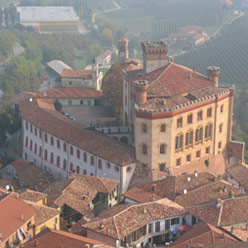
The town of Verduno dates back to the roman age, it has been chosen by the rich people of Alba and Pollenzo as the place to build their houses. The name Verduno has been given later by the Celts and it means "fertile hill". The castle, built in 1600 for the marquis of Verduno, has been bought two hundred years later by Carlo Alberto. The Italian king chose to buy the castle and part of the surrounding hills to obtain one of the most pleasing wines of all, that is the Barolo. Now it is a celebrated restaurant.
Aerial View of Verduno
Alba is considered the capital of the Langhe, this fact is shown by two tousands of story of this city. It is placed in a plain crossed by the river Tanaro, inside a valley formed by the hills of Langhe and Roero; it has always represented the main centre for exchanging typical products. Alba is represented by its towers, the legend tells that in the medieval age there was about an hundred of towers. Today only ten towers, or few more, still exist, but those are enough to give an unique appearance to the town. In october Alba reaches its maximum splendour, in fact the triffle fair takes place inside the city, and this event is now famous even in foreign countries. In the streets of the centre, characterized by a pure medieval look, are built many restaurants that offer the opportunity to taste the pleasing triffle, along with the most famous wines of the nearby hills.
Alba's symbols: the towers and the truffle
Barbaresco dates back to the roman age. In that period the vines from which the village takes its name, that is Barbaresco, were already famous. This vines are obtained from the vines of Nebbiolo, but the wine is characterized by a lower quantity of alchool and it is milder compared to Barolo (which vines have origin from the same of Barbaresco). In the village there is also a castle with a really high tower (36 metres) directly over the Tanaro river.
View of Barbaresco
Neive, the most important centre in the Tinella valley, is 12 kilometres far from Alba. It is an ancient village, as confirmed by the lots of roman tombstones and the flooring of some of the village's streets. Besides, the ancient village is placed in the higher part of the town, and it is one of the most rich and famous in the whole country, cited also in the touristic guide "I Borghi più belli d'Italia" (the beautiest italian villages). Neive is also the cradle of many culinary specialities, Piedmont meat and DOCG wines: Moscato, Nebbiolo, Dolcetto, Barbera.
View of Neive ancient Village
Pollenzo is built on the shores of the river Tanaro, and it is one of the cities belonging to the province of Bra. The village was founded in the roman age, in that period it was more vast than now. In 1762 it became part of the properties of the Savoia house, it has been given more importance to that zone and many archeological sites were discovered. Today the "Università del Gusto" (University of taste) inside the city has an international fame. The environment offers important teachings given by famous chefs and cooks famous all over the world.
The central square of the town
The village of Cherasco has strict roman origins, this fact is shown by its streets and the churchs, among which the ones of San Pietro and San Martino should be remembered, containing artpieces created before the eleventh century. Today the town offers two fairs: the antique market ant the slug fair. Cherasco is surrounded by the silent atmosphere of streets that are now like they were in the ancient days, when this town was as important as Torino.
Cherasco's ancient starlike walls
- Back to the top of the page -
  English version - Versione italiana 
Saluzzo is a small but charming town in the province of Cuneo, a place where the Monviso valleys gently fade into a plain rich with fruit trees. Saluzzo has been the capital of a marquisate for four centuries, and its oldest part has kept its medieval urban plan almost unchanged. Formerly the town - sprawling on the hill - was circled by two rows of walls. The towering Castle (known as La Castiglia) looks down on a borough crammed with cobbled narrow streets and steep steps, churches and elegant palaces with balconies or roof-terraces.
Saluzzo and the Monviso view